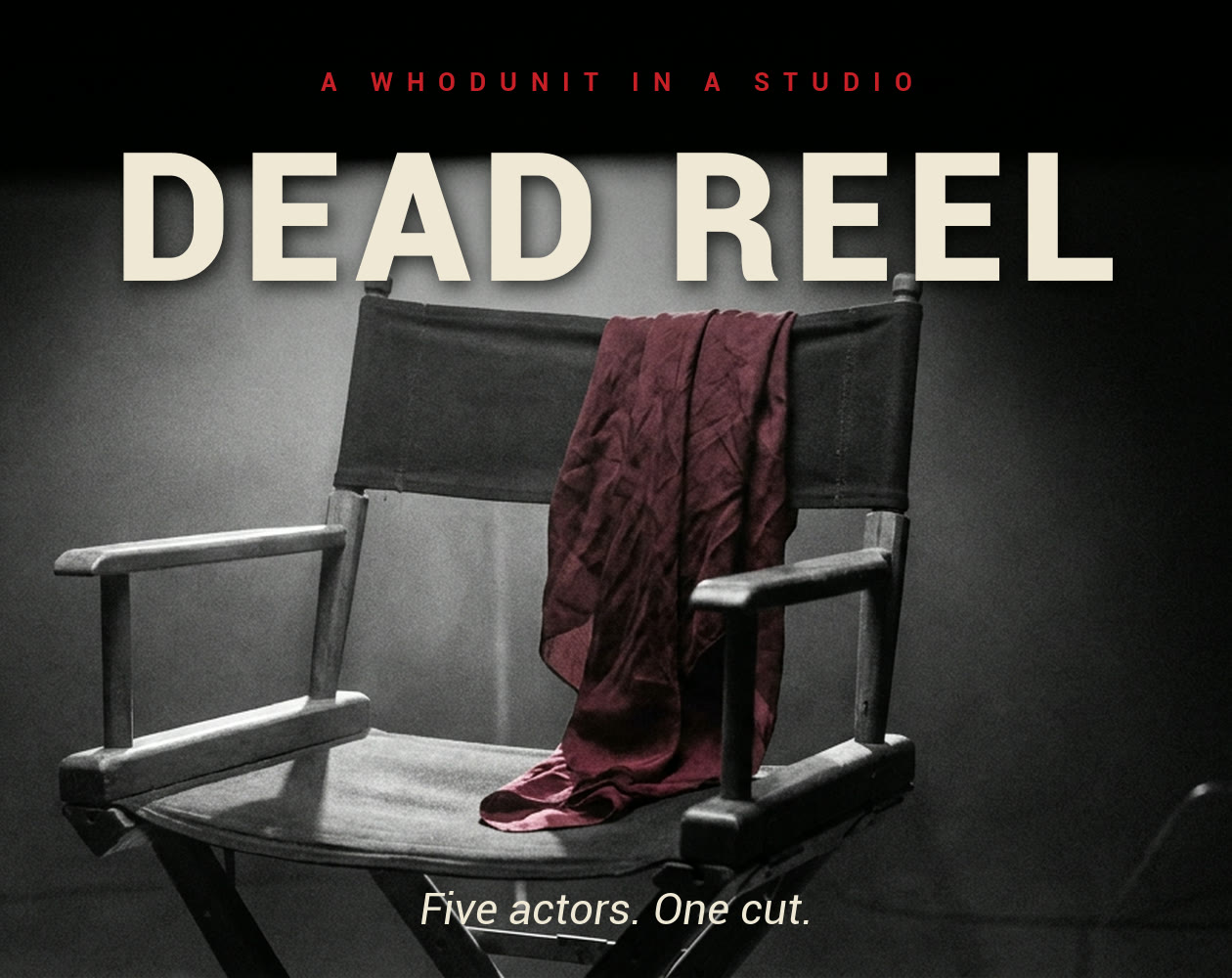
Dead Reel: What I Built for the 2026 Epic AI MegaJam
I spent the last four days building a game, solo, for the 2026 Epic AI MegaJam. It is called Dead Reel. It is a whodunit set on one film soundstage, and almost every part of it was made with an AI tool that I directed.
This post covers three things: what the jam asked for, what I built, and the full list of tools and models I used.
- Play in a desktop browser (Chrome or Edge): deadreel.buckley-builds.com
- Windows download and jam page: buckley603.itch.io/dead-reel
The jam guidelines
The theme was Director’s Cut. These were the rules that shaped the work:
- Engine: Unreal Engine or UEFN. Web builds had to be packaged with the Unreal Engine 5.9 MegaJam Preview.
- Team: solo, or up to five people.
- Time: work started on November 12. The deadline was November 15 at 5:59 PM Pacific. A late entry is disqualified.
- Web build: a Shipping build with
index.htmlat the top of the zip, under 500 MB in total and under 200 MB per file, marked playable in the browser on itch.io. - Desktop build: a packaged zip under 1 GB, named
TeamName_GameName. No unpackaged projects. - Required on the form: team name, each member’s name and Epic account email, the game’s name, and a gameplay video of 30 to 60 seconds.
- Disclosure: list every third-party asset, and declare anything made before November 12.
- Judging: 1 to 5 on ambition and innovation, use of the theme, fun, gameplay, visuals, level design and progression, and audio.
Partner prizes also asked entrants to list the tools they used, which is one reason this post exists.
What I built
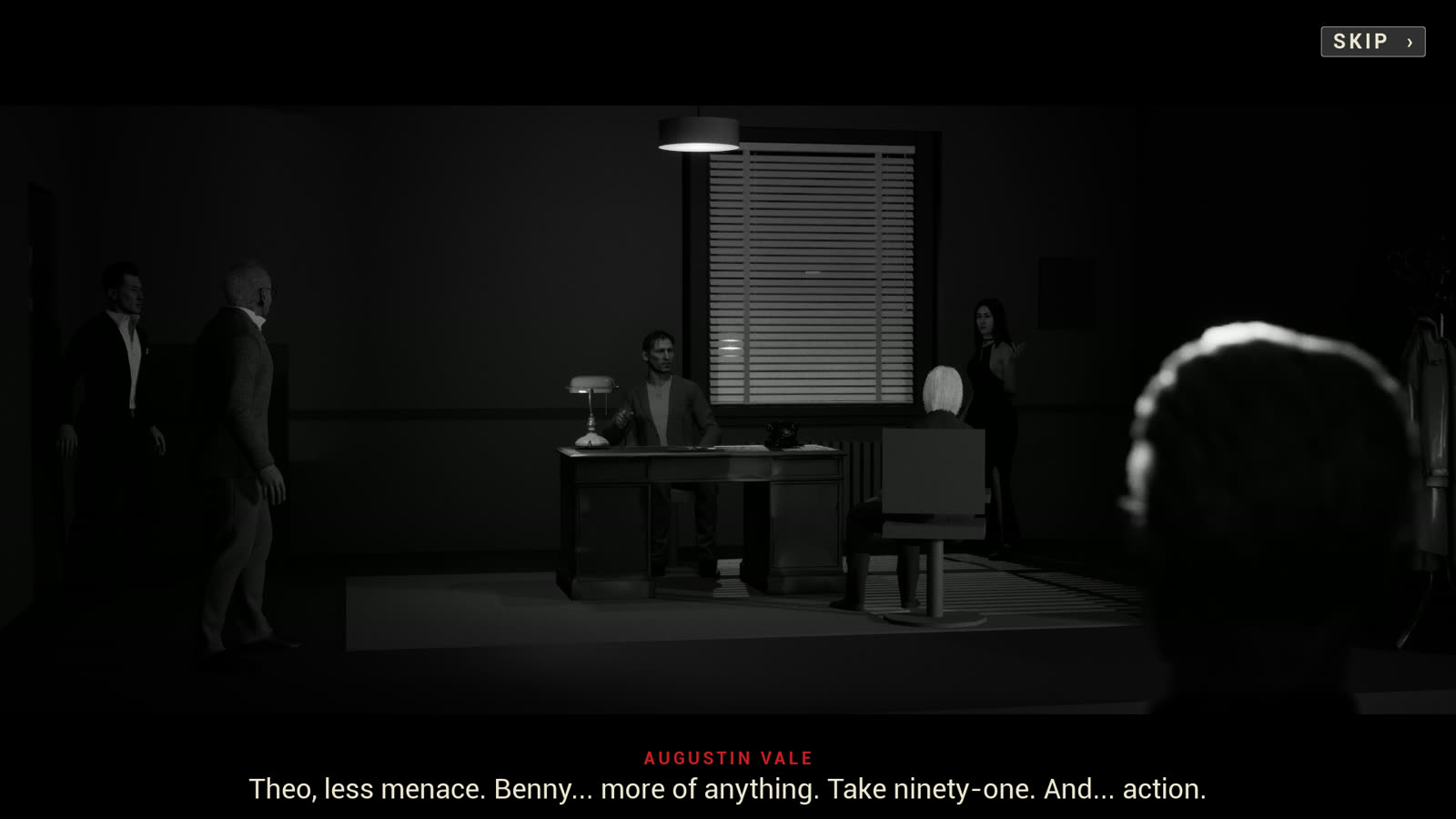
Tyrant director Augustin Vale is filming a noir called The Long Goodnight. He calls cut, and the crew takes ten. The stage blacks out for ninety seconds. When the lights come back, Vale is dead on the Main Set, and one of his five actors did it.
You play Jo, the script supervisor. You are never seen and never heard. Your job is continuity, so you solve the murder the way a script supervisor would: by finding what does not match.
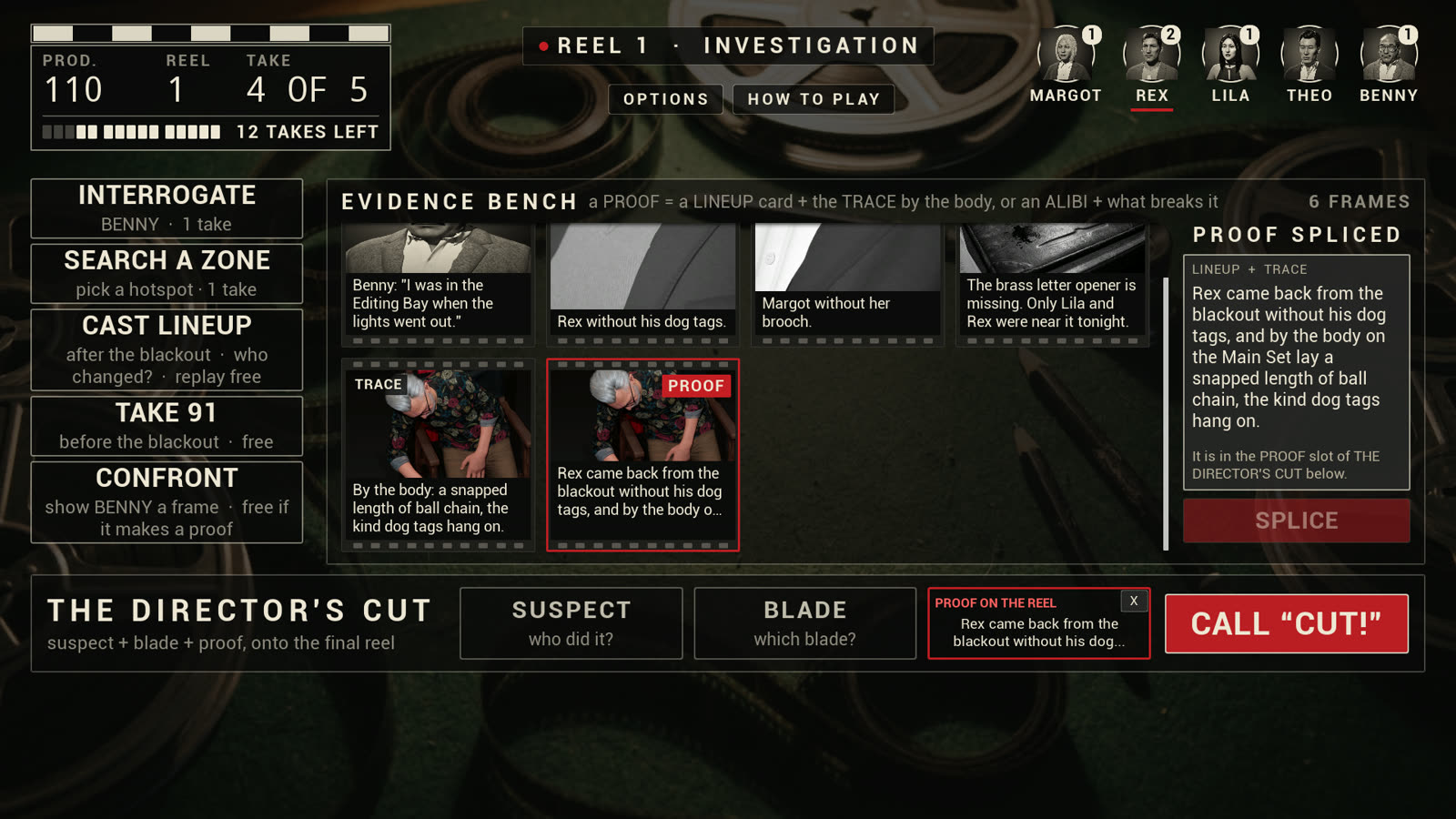
- Question the cast in the makeup mirrors. Each suspect has an alibi, a secret and a tell.
- Search five rooms of the soundstage for what moved during the blackout.
- Screen the dailies and look for the slip: a fresh bandage, a missing accessory, a changed costume.
- Splice the evidence. Every clue is a frame of film. Drag two frames together. If they contradict each other, they splice into a proof.
- Call the cut. Your accusation is the Director’s Cut: a suspect, a blade and a proof. The right cut plays the confession. The wrong cut is a box-office flop, and the picture shows you the frame you missed.
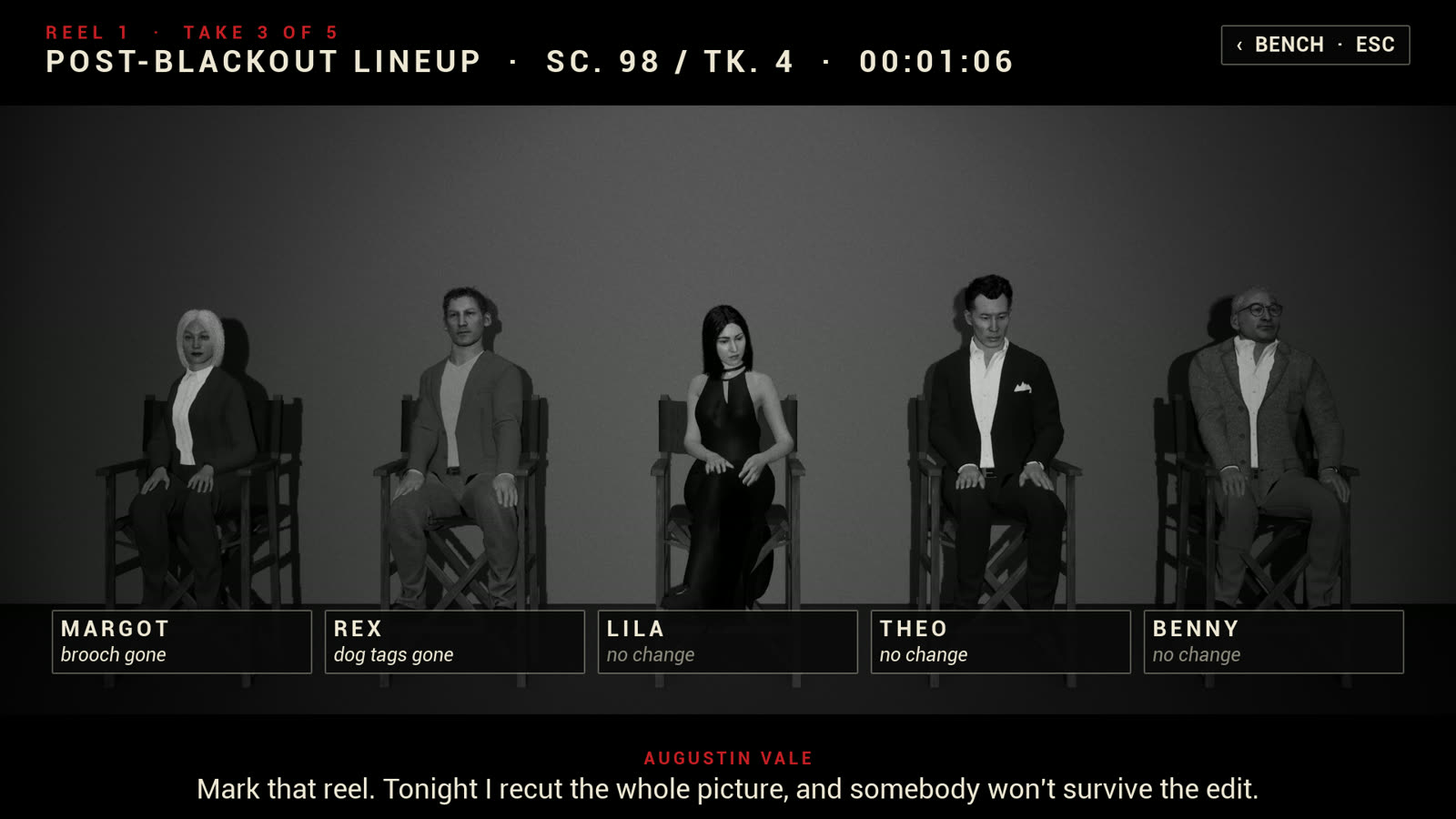
Every action costs a take. Easy gives you 20 takes, Normal 10 and Hard 5, split across three reels. A full case runs about 20 minutes.
The killer and the blade change with the production number you type on the clapperboard. The same number is always the same case, so you can hand a number to a friend and compare cuts.
Some numbers from the finished project:
- 6 MetaHuman cast members, each with a fitted face, a wardrobe and a voice
- 734 recorded voice lines, each with its own baked lip sync
- 5 recordings of every suspect answer and 17 of every one of Vale’s insults, so a new case sounds different
- 10,000 production numbers checked by an automated test to have exactly one fair answer
- 85 automated tests run before every build
One rule held from the first day: nothing is generated while you play. The cases are written in code. Every line was recorded once and plays back as audio. The game makes no calls to any AI service at runtime.
How it was made
I worked as the director. The AI tools were the crew. I wrote the design, approved every look, listened to every voice pick and played every build. The agents wrote the code, drove the Unreal editor, generated the assets and ran the tests.
Three coding agents shared one branch: Claude Code, OpenAI Codex and Cursor. Only one of them was allowed to drive the Unreal editor at a time, with a lock file to enforce it. The others took work that did not need the editor, such as code review, tests and documentation.
Hard tasks went up a ladder of models. A task started on Claude Sonnet. If it failed, it went to Claude Opus, and then to Claude Fable. If Fable failed too, the agent wrote down the blocker and moved on.
Two habits saved the most time:
- Reference sheets before generation. Before any image or 3D model of a character or prop was generated, I had the agents make one all-angle reference sheet and treated it as canon. 3D models were generated from several views of that sheet. The first prop batch skipped this, and a crystal shard came back as a cup.
- Checking what the player sees. The agents captured the running game and looked at the frames. A late audit found a line that said “plaster on the hand” over a model wearing a band-aid. Text and picture now agree.
Every tool and model I used
Engine and characters
- Unreal Engine 5.9 (the MegaJam Preview), with the Wasm platform and WebGPU for the browser build
- MetaHuman Creator for the six cast members
- MetaHuman Animator for lip sync, solved offline from the recorded audio of each line
- Fab for clothing packs and glasses, fitted to the cast
- Blender for prop clean-up and for the cast’s small accessories, modelled by script
Language models, with counts
These numbers come from the session logs on my machine, counted on the evening of November 15. They cover November 12 to 15 only.
| Model | Maker | Used through | Count |
|---|---|---|---|
| Claude Opus 5.5 | Anthropic | Claude Code | 17,948 responses |
| Claude Fable 5.2 | Anthropic | Claude Code | 5,095 responses |
| Claude Sonnet 5.5 | Anthropic | Claude Code | 878 responses |
| Claude Haiku 5.5 | Anthropic | Claude Code | 9 responses |
| GPT-6 Astra | OpenAI | Codex | 21 turns in 5 sessions |
| GPT-6.1 Sol | OpenAI | Codex | 8 turns in 2 sessions |
| Grok 4.7 | xAI (SpaceX) | Cursor | 165 messages in 1 session, 112 of them tool calls |
A Claude Code “response” is one reply from the model, and a single task can take hundreds of them. A Codex “turn” is one request from me, which the model answers with many steps of its own. So the rows are not directly comparable, but the shape is right: Claude did the bulk of the work, about 23,900 responses in four days, and wrote about 21.7 million tokens of output.
What each did:
- Claude Opus 5.5 carried most of the gameplay code, the editor scripting, the sequences and the tests.
- Claude Fable 5.2 took the hard tasks that Opus could not finish, the final audits and the shipping work.
- Claude Sonnet 5.5 and Claude Haiku 5.5 handled small, mechanical jobs.
- GPT-6 Astra and GPT-6.1 Sol, in Codex, did code and review work away from the editor.
- Grok 4.7, in Cursor, took six documentation tasks from the project board on the first morning.
Unreal editor tooling for agents
- VibeUE: my MCP tooling that lets an agent drive the Unreal editor
- Vibe3D and VibeMetaHumans: my plugins for modelling and for MetaHuman work from an agent
- Unreal Game IQ and the Unreal Engine Skills library: engine knowledge the agents look up before they write engine code
- Epic’s own AI toolsets in Unreal Engine 5.9, including Python scripting, Sequencer and automation tests
Voice, sound and music: the Tonetta models
Every sound in the game came through Tonetta. These are the models it ran, with the number of generations in my spend log:
| Tonetta model | What it made | Generations |
|---|---|---|
| Voice Studio (voice design) | 21 designed voices: three options for each of the seven speaking roles | 7 design runs |
| Voice Studio (speech) | Every spoken line, including retakes | 847 |
ElevenLabs Sound Effects v3 (sfx-elevenlabs-v3) | Sound effects and stingers | 19 |
Stable Audio 3 Medium (music-sa3-medium) | The score and its variations | 18 |
| Tonetta Sound agent | One test: turning a music cue into a seamless loop | 1 session |
734 of the 847 speech generations are lines that ship in the game. The rest are retakes of lines that came out wrong.
SoX and FFmpeg conditioned the audio before import.
Images and 3D
| Model | Used through | What it made | Logged jobs |
|---|---|---|---|
| Nano Banana Pro | fal.ai | Reference sheets, concept art, title art and evidence frames | 212 (some jobs are batches of images) |
| Hyper3D Rodin (Gen-2 and Gen-2.5) | Hyper3D and fal.ai | Hero props: the five blades, the director’s chair, the camera dolly | 41 |
| Tripo (v2.5 and H3.1) | fal.ai and Tripo Studio | Set dressing: film cans, crates, lamps, furniture | 45 |
| Kling (v2.5 Turbo and v3) | fal.ai | Short video clips used as motion and pose reference | 5 |
Animation
- NVIDIA Kimodo: text-to-motion for body animation, retargeted onto the MetaHumans
Shipping
- itch.io and butler for the Windows build
- Cloudflare (a Worker in front of R2 storage) for the browser build
What I would tell another team
- Get the web build running on day one. Mine booted in a browser on the first night. That kept every later decision honest about size and performance.
- Watch the per-file limit, not just the total. The browser build is a 454 MB download, under the 500 MB cap. But one data file is 411 MB, over the 200 MB per-file cap, so it could not be the itch.io browser build. It is hosted on my own domain, and the Windows build is the jam entry.
- Budget for browser audio latency. Sound comes out about a tenth of a second later in a browser than on Windows. Lips moved ahead of voices until I delayed the face animation to match. There is now a lip sync setting in the options screen.
- Phones are a different project. The browser build needs WebGPU and a lot of memory. It runs in desktop Chrome and Edge, not on an iPhone.
- Keep the tests. The 10,000-case test caught unfair cases long before a player could.
Play it
- Browser, desktop Chrome or Edge: deadreel.buckley-builds.com
- Windows and the jam page: buckley603.itch.io/dead-reel
Type 105, 110 or 114 as the production number for three different killers. Any other number is a new case.
That’s a wrap.